Instrumentation – Observing, Computing, Printing
Astronomy Camp has a large array of instruments that can be installed on our telescopes, providing excellent capabilities and flexibility!
Evening Observing
-
-
- An Santa Barbara Instrument Group CMOS camera (Aluma AC404 ) (4096×4096 pixels) on the 24” and 32” telescopes.
- Two ZWO CMOS cameras for general use with imaging and spectroscopy: ASI6200mm Pro (43.3 mm diagonal; 3.8 micron pixels) and ASI533MC Pro (16 mm diagonal; 9 micron pixels).
- Prime focus HyperStar optics with the ASI533MC Pro camera on a Celestron 8-NextStar Evolution telescope. A SXVR-H694 camera is also available.
- The ASI6200mm Pro camera can be used with filters (LRGB; H-alpha,O III, SII) at the Cassegrain focus of the 24”, 32”, and 61” telescopes.
- A ZWO ASIAIR Pro WiFi controller can remotely control the above cameras and 8-inch telescope for long-exposure imaging with active image stacking.
- Digital SLR Canon cameras such as an optimized Canon 80D for astrophotography adaptable for all our telescopes or with separate tracking mounts like Star Adventurer.
- Celestron smartphone NexYZ-3axis mounts
- Byers polar-tracking system, Cam Trak
- Numerous 1.25″ and 2″ Televue eyepieces (including a 55mm Ploessl, 41mm & 35mm Panoptic), filters (nebular, solar, lunar) for all telescopes.
- Hand-held cameras for exploring the environment in both the ultraviolet (UV) and infrared (IR).
- Using spectroscopic techniques, Campers dissect the light coming from astronomical objects to determine their physical and chemical properties! The CampSpec instrument can be used visually (by eye) or electronically with the ASI6200mm Pro camera and a slit-viewing camera (ASI224MC).
- As a backup to CampSpec, an SBIG Model SGS spectrograph is available with a Starlight Express SXVR-H694 camera.
- Diffraction gratings (“grisms”) can be threaded into 1.25″ eyepieces for low spectral resolution, for both visual use and electronic spectroscopy on all our telescopes (8-61″).
-
The following instruments are sometimes available for an Advanced Camp:
-
-
- Infrared imaging with a 2MASS IR camera on the 60-inch telescope of the University of Minnesota.
- A world-class 4096×4096 pixel CCD for imaging at the 61″ Kuiper telescope
- A state of the art 4096×4096 pixel thinned-CCD prime focus camera at the 60″ telescope that covers a one-degree field of view (4 full moons).
- PISCES: A 1024×1024 pixel wide-field near-infrared (1.0-2.5 microns) camera, still used for active research, can be used at the 61″ and 90″ telescopes for Advanced Camps.
-
Daytime Observing
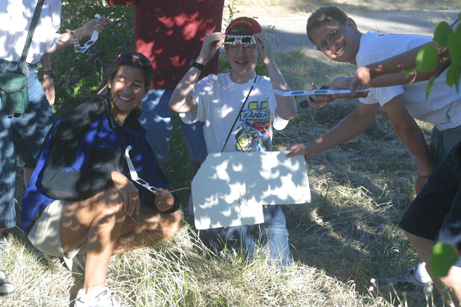
Astronomy Campers also observe the Sun with a wide variety of gadgets for safely viewing the photosphere, chromosphere, sunspots, prominences, and flares.
-
-
- A Day Star hydrogen-alpha filter for observing prominences, flares, granulation, and general activity on the Sun. Its bandwidth is 0.6 Angstroms. It can be used on an 8-inch Celestron telescope.
- A Coronado Instruments Calcium-K filter for observing solar magnetic activity.
- A homemade Sun Gun for directly imaging the Sun in broad-band visible light.
- A classic Questar 3.5” telescope for continuum imaging of the Sun’s photosphere.
- Two models of Sunspotter.
- BinoMite binoculars from Coronado.
- Two Astroscan telescopes for viewing the photosphere by eyepiece projection.
- Spectroscopes for examining spectral lines (absorption and emission) in laboratory light sources and the Fraunhofer absorption lines in the Sun’s spectrum.
- Pinhole cameras using the dark interiors of our telescope domes.
- Eclipse glasses for direct viewing of sunspots.
-

Computing
With the development of sensitive solid state light detectors and the spreading of scientific discoveries via the Internet, computers have become a mandatory tool for research astronomers. Likewise, Astronomy Camp participants have access to the same variety of software and hardware tools. Camp faculty and counselors are well versed with the computers’ capabilities. With the facilities available, Campers are able to:
-
-
- Explore the Internet using 15 Chromebook tablets for information on particular astronomical topics or area of research. Research journals now publish their contents online!
- Campers have access to Goggle Suites educational software.
- Take digital images (CCD and CMOS) and/or spectra of their objects.
- Analyze their images and/or spectra via the same data reduction and analysis software used by research astronomers (Python, SAOImage DS9, IRAF, IDL, etc.) as well as popular packages such as MaximDL, AstroImageJ, …
- Store their data on Google Drive. Campers can then continue to investigate their images and spectra at home after Camp has ended.
-
In addition to the computer systems resident at the specific telescopes, Campers can also use six different laptops dedicated to analyzing astronomical data, such as ASUS ZenBooks running both Windows 10/11 and Linux operating systems.
3-D Printing
Campers have access to an Ultimaker 3-D printer and associated software to develop .STL files of planetary landscapes, NASA models, etc. Campers can develop their own projects and also manufacture components needed in various engineering efforts during Camp.